How Tree Stump Grinding Actually Works
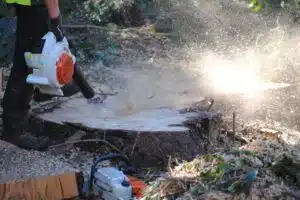
Stump grinding works by a rotating cutting wheel chipping the stump and its surface roots down below ground level, after the site, the access route and any underground services have been checked.
We start with a walk around the site, not the machine. We confirm the way in (a side passage, a rear lane, sometimes through the house on a terrace) and check for anything buried that a cutting wheel could hit, like gas, water, stormwater or irrigation lines. Services can sit shallower than people expect. Before You Dig Australia provides free plans of underground assets for planned work sites, and checking them is a sensible first step whenever a machine is working close to the ground.
Once that’s clear, the cutting wheel works across and down until the stump and its surface roots are wood chips and sawdust.
Why Tight Access Changes the Whole Job
On a tight Sydney block, access decides how a stump grind goes far more than the size of the stump does.
A job we see often on tight Sydney terraces is a stump within arm’s reach of a shared boundary fence or a stormwater pit, where an experienced operator matters more than the machine. Compact and wheeled grinders are built for narrow side passages and small backyards, so a tight block is rarely a reason to rule grinding out. The real constraint is usually clearance around meter boxes, outdoor taps and narrow gates, which we check on site before quoting.
On inner-city jobs the access plan usually comes down to a handful of things: the width of the side passage or gate, steps or changes of level on the way in, low branches or structures overhead, and how close the stump is to a fence or wall. Spotting these on the site walk, rather than halfway through the job, is a big part of what an experienced operator brings.
Why Grind a Stump at All, and When to Leave It
People usually have a stump ground because it’s in the way, whether of lawn, paving, a new garden bed or building work, because it’s a trip or mowing hazard, or because it keeps sending up shoots. If none of that applies, leaving it is a legitimate choice, and I’ll say so.
A stump left in the ground doesn’t disappear quickly. It breaks down slowly, and while it does it can still be in the way, so it’s worth deciding what you want that spot to be before choosing between grinding, excavating or leaving it.
Grinding vs Excavation vs Chemical Removal
Grinding, excavation and chemical removal are the three common ways to deal with a stump. For most residential jobs grinding is the practical choice, but it isn’t the only one.
| Method |
Best suited to |
What you’re left with |
| Grinding |
Most residential jobs, including tight access |
Wood chips on the surface; the roots break down underground over time |
| Excavation |
Replanting in the exact same spot, or full root removal |
An open hole to backfill; needs more space and heavier equipment |
| Chemical removal |
Sites where the stump can’t be reached and there’s no hurry |
Undisturbed ground, but breakdown is slow, far slower than most people expect |
I rarely recommend chemical removal when you want the space back soon.
How Deep We Grind and What You’re Left With
We grind to the depth that suits whatever is going into that spot next, rather than to a fixed number, and leave the ground level. Wood chips can stay as mulch or go as green waste.
One honest limitation worth knowing: in my experience grinding stops regrowth in most cases, but a few vigorous species can occasionally send up suckers from roots left in the ground, however deep the grind. If that’s a realistic risk for your tree, we’ll say so before we start rather than oversell a single-visit fix.
What Affects a Stump Grinding Job
A stump grinding job is shaped by the size of the stump, how far its roots spread, how tight the access is and what’s in the ground around it. Those same factors decide how long the job takes, which is why we look at the site before quoting.
- Size and spread: in my experience, a large stump with wide surface roots takes noticeably more work than a small, tidy one.
- What’s in the ground: rocks, old paving, irrigation lines and buried services all change how we approach it.
- Access: a narrow passage or gate limits the machine we can bring in.
- What’s going there next: turf, a garden bed or paving each suit a different finished depth.
We don’t quote without seeing the site, because two stumps that look similar from the street can be very different jobs once we’re on site.
How to Prepare for a Stump Grind
The best preparation for a stump grind is clearing the way in, telling us what you know about what’s underground, and deciding what the spot will be used for afterwards. A little groundwork makes the day safer and smoother.
- Clear the access route of bins, pots, furniture, vehicles and anything else in the way.
- Tell us about any irrigation, cables or pipes you know of, and any past work in that part of the garden.
- Let us know who owns the boundary fence or wall next to the stump.
- Decide what’s going there afterwards, so we can agree the grind depth with you.
- Keep children and pets well away from the work area on the day.
Council and NSW Tree Rules to Check First
In NSW, whether you need approval to remove a tree depends mostly on your local council. Councils can declare which trees need a permit through their development control plan, under Chapter 2 of the state’s Biodiversity and Conservation SEPP 2021, so the answer can differ from one council area to the next. The NSW Department of Planning explains the current framework on its vegetation in non-rural areas page.
If the tree is still standing, that question comes before any stump work, so check your council’s tree rules before anything is cut. Our council regulations page is a useful starting point, and our tree removal page explains that stage. These rules may be changing, so see the note below the FAQs.
What to Ask Before You Book a Stump Grinder
Ask any operator three things: are they insured, how do they check for underground services, and how will they protect neighbouring fences and garden beds? Arboriculture Australia, the national industry body I’m a member of, is a good place to see what professional standards look like.
FAQs About Tree Stump Grinding
Does grinding a stump stop it growing back?
In my experience, grinding stops regrowth in most cases, because it removes the stump and its growing point below ground. A few vigorous species can occasionally send up suckers from roots left in the ground, however deep the grind, so if that’s a risk for your tree, we’ll say so before we start.
How deep does stump grinding actually go?
It depends on what’s going there next. Turf needs less depth than a garden bed with deep planting, so we agree a target depth with you on site before starting rather than grinding to a fixed number.
Do underground services need to be checked before stump grinding?
Yes. Gas, water, stormwater and irrigation lines can sit closer to the surface than people expect, and a cutting wheel can damage them. Before You Dig Australia provides free plans of underground assets for planned work sites, and we also walk the site and check before any machine is switched on.
Can a stump be ground out in a narrow side passage or small backyard?
Yes, in most cases. Compact and wheeled grinders are built for exactly this, and the real constraint is usually clearance around obstacles like meter boxes, taps or narrow gates rather than the passage width itself. We check this before quoting.
Can I grind a stump myself?
You can hire a grinder, but it’s heavy, demanding work, and the usual surprises are buried services, rocks and old paving. A damaged service line or neighbour’s fence is a headache you don’t want. Safe Work Australia publishes a guide to managing the risks of tree work, written for people who do it professionally, and that’s a fair indication of how seriously the industry takes it.
Tree Removal Rules in NSW May Be Changing
The NSW Government has proposed changes to how illegal tree and vegetation clearing is handled in non-rural areas, including significantly higher penalties, replacement planting as a permit condition, tighter exemptions for dead or dying trees (with qualified arborist certification) and a narrower exemption for trees posing an imminent risk. When this article was last updated in October 2026, the proposal was still a draft, with final amendments expected in the second half of 2026. Check the NSW Planning Portal’s Protecting our trees page and your council before relying on any of this.
If you’re ready to get a stump ground out, our stump grinding service page has the full process and how to arrange a quote for your property.
Disclaimer: This article is general information based on Arbor Pride’s professional experience and is not a substitute for a site-specific assessment. Tree health, safety risk, and legal requirements, including council permits and Tree Preservation Orders, vary by property, tree, and council area, and can change over time. Always arrange an on-site consultation with a qualified arborist and confirm current requirements with your local council before removing, pruning, or otherwise working on a tree.
About the Author
Julian Parry is the founder and managing director of Arbor Pride, with more than 20 years’ experience in arboriculture, and he still gets a kick out of watching a well-cared-for tree thrive. He’s a qualified arborist and horticulturalist holding Australia’s highest arborist rating, AQF Level 5 Consulting Arborist, and is a member of Arboriculture Australia, the Tree Contractors Association of Australia and the International Society of Arboriculture. Julian’s philosophy has always been preservation before removal, and he leads a fully insured team, backed by $20 million public liability cover, delivering everything from tree care and removal to arborist reports like tree risk assessments and tree protection plans for councils, schools and developers across Sydney’s North Shore. That approach has earned Arbor Pride 300+ five-star reviews and long-standing partnerships with councils and businesses across Sydney, and you can read more about our work on the Arbor Pride homepage.