Across the deserts of northern China, a new generation of solar-powered autonomous robots are transforming the way trees are being planted in order to combat the decades-long struggle against desertification. These machines are part of China’s large-scale ecological restoration efforts, including the long-running “Green Great Wall” initiative which began way back in 1979 and was designed to slow the spread of deserts, minimise sandstorms and restore the ravaged landscapes of Northern China.
Planting trees in these desert-type environments have traditionally been restricted to a smaller scale simply due to the extremely labour-intensive nature of it. Workers must dig holes in hard, dry soil, transport seedlings across vast sand dunes, and water the plants in harsh conditions. So, to address these challenges, engineers and researchers have developed intelligent tree-planting robots that can operate with minimal human supervision. Running on solar energy, this allows them to function in remote desert areas where the electricity infrastructure is limited or even non-existent.
These modern desert-planting robots are a combination of robotics, artificial intelligence, and renewable energy and are equipped with sensors and cameras that can analyse the terrain and identify suitable planting spots, all while avoiding obstacles such as rocks and existing vegetation. Some prototypes are even capable of performing the entire planting process autonomously – loosening the soil with drilling tools, inserting a sapling, covering it with sand, and watering it in. Quite remarkable indeed!
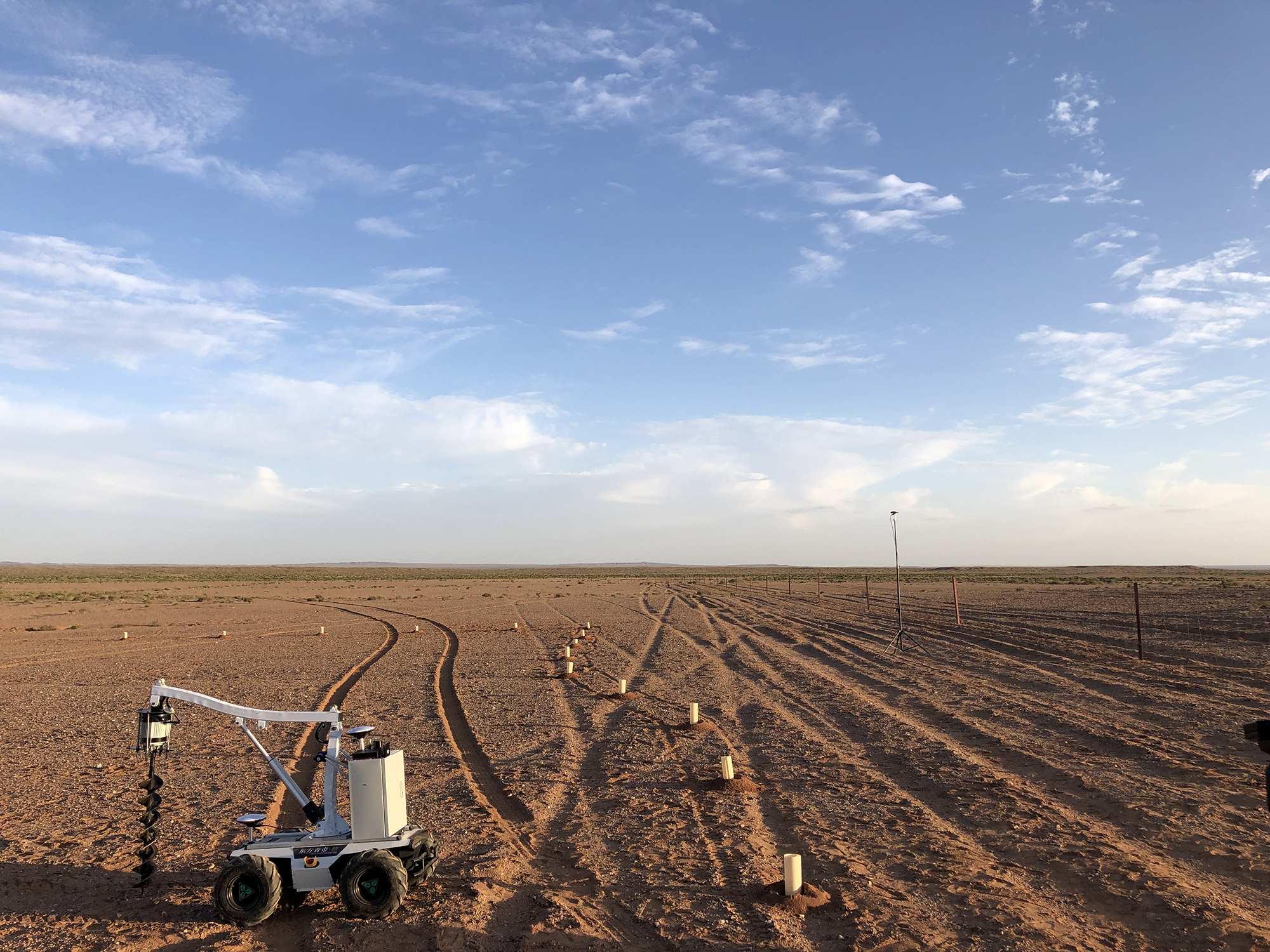
In some experimental projects in Inner Mongolia, intelligent planting machines have also been shown to plant a seedling in under five seconds, dramatically increasing the planting speed compared to that of manual labour. In another demonstration, a single robot planted 160 seedlings in one acre in just 20 minutes, something reputed to be more than 10 times higher than traditional manual labour methods and with a much higher seedling survival rate of around 70-80%.
Solar power plays a key role in enabling these technologies. With abundant sunlight in these desert regions, the robots can recharge as they carry out their tasks, making it possible to conduct large-scale planting campaigns without relying on any fossil fuels and with minimal extra labour needed. This renewable energy supply also supports a round-the-clock operation that reduces any additional environmental impact that large-scale restoration projects can sometimes be known for.
As China and the world continue to develop these robotic and AI technologies, fleets of autonomous tree-planting robots may soon work together across deserts not just in China but in other environmentally ravaged landscapes around the world.
