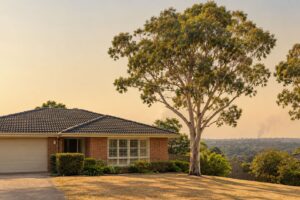
The Pre-Season Tree Checklist I Use Before Bushfire Season
When my team goes out to check a property ahead of bushfire season, we’re looking at three things, in this order:
- Deadwood and dead limbs in the crown. This is the fuel that catches first and burns fastest.
- How close branches sit to the roofline, eaves and gutters. This is the most common way embers and flame get a foothold on a house.
- The gap between one tree’s canopy and the next, since fire can move from tree to tree if crowns are touching or close.
None of this requires removing a healthy tree. Most of the time it’s a prune, not a removal, which is exactly what our tree pruning service is for, and it’s a job worth doing well before the Bush Fire Danger Period opens rather than in the middle of it.
If you want numbers to work to, the NSW RFS standards for Asset Protection Zones say tree crowns should be separated by two to five metres and a canopy should not overhang within two to five metres of a dwelling. Those standards are written for formal asset protection zones, so treat them as a benchmark for your own block rather than a rule, and ask us if you’re not sure where your trees sit.
How Far Should Trees Be From My House for Bushfire Safety?
As a rough rule, CSIRO’s bushfire research recommends keeping trees at least one and a half times their mature height away from a building, mainly so a falling limb or trunk can’t reach the structure. It’s a guideline rather than a guarantee, and it isn’t always achievable on a typical Sydney block, which is exactly why the maintenance side (removing deadwood, clearing low branches, keeping canopies separated) matters just as much as spacing. If your trees are already closer than that, good maintenance does most of the work that distance would otherwise do.
The 10/50 Rule: What It Actually Means for Your Trees
The 10/50 Vegetation Clearing Entitlement lets eligible property owners remove trees within 10 metres of their home and clear other vegetation within 50 metres without needing council approval, measured from the external walls of the building. I’ll be upfront about the catch: eligibility depends on your specific address, not just your suburb, so check the NSW RFS’s own eligibility tool before assuming it applies to you. The RFS says to check it on the day you clear and keep a record of your search, because entitlement areas can change. I’ve seen people assume they qualify and start clearing without checking first, which can land you in a difficult conversation with your council if it turns out you don’t.
Do You Need Council Approval to Prune or Remove a Tree for Bushfire Safety?
Whether you need council approval depends mostly on your local council’s development control plan, and the 10/50 Rule is the main exception for properties that qualify. Outside it, the rules differ from one council to the next, so check yours before any significant pruning or removal.
The NSW Government’s framework, Chapter 2 of the Biodiversity and Conservation SEPP 2021, lets councils decide what needs a permit. The Department of Planning explains this on its vegetation in non-rural areas page, and our council regulations page is a good starting point for your area.
Should You Remove a Tree Before Bushfire Season?
My honest answer is: usually not, and only if it’s genuinely warranted. My approach has always been preservation before removal, and bushfire season doesn’t change that. If a tree is healthy, well clear of your roofline and free of deadwood, removing it is unlikely to make your property meaningfully safer, and you lose the shade, privacy and, yes, the wind and ember protection a good tree provides.
Where I would recommend removal is when a tree is already in poor health, structurally unsound, or so close to the house that pruning genuinely can’t fix the problem. That’s a judgement call worth getting a second opinion on rather than guessing, which is exactly what a proper Tree Risk Assessment is for. If a tree does have to come down, our tree removal service can help, and a tree removal justification report can support your application where council asks for one.
Related Reading
FAQs About Preparing Your Trees for Bushfire Season
Do trees make bushfires worse?
Not on their own. A tree becomes a fire risk when it’s carrying deadwood, has branches touching a roofline, or sits too close to another tree’s canopy. A healthy, well-maintained tree with good clearance can actually help shield a home from wind, heat and embers rather than add to the risk.
How far should trees be from my house for bushfire safety?
CSIRO’s bushfire research suggests keeping trees at least one and a half times their mature height from a building, so a falling limb can’t reach it. Where that’s not possible on a smaller block, keeping the tree free of deadwood and low branches matters just as much.
What is the 10/50 Rule and does it apply to my property?
The 10/50 Vegetation Clearing Entitlement lets eligible NSW properties clear trees within 10 metres and other vegetation within 50 metres of a home without council approval. Eligibility is address-specific, so check the NSW RFS’s own online tool on the day you clear before assuming your property qualifies.
When does bushfire season start in NSW?
The NSW Bush Fire Danger Period officially runs from 1 October to 31 March, though some council areas bring it forward. It’s worth having any tree work done before this window opens rather than during it, but if it has already opened, don’t wait for next year.
Should I remove a tree before bushfire season?
Usually not, if the tree is healthy. Removing a well-maintained tree rarely makes a property meaningfully safer and costs you the shade and protection it provides. Removal is worth considering only when a tree is already unhealthy, structurally unsound or too close to the house for pruning to fix.
Tree Removal Rules in NSW May Be Changing
The NSW Government is considering changes to its tree clearing rules under a proposal called Protecting our trees. As at 6 October 2026 it is still a draft, with final amendments proposed for the second half of 2026. The proposals include higher penalties, replanting as a condition of permits and tighter exemptions for dead, dying or imminent-risk trees, which matters if you are thinking of removing a dead tree near your home. You can read the details on the NSW Planning Portal. Please check with your council before any work, because the rules may have changed by the time you read this.
If you would like a second pair of eyes on your trees before the season gets going, contact our team to book an on-site assessment.
Disclaimer: This article is general information based on Arbor Pride’s professional experience and is not a substitute for a site-specific assessment. Tree health, safety risk, and legal requirements, including council permits and Tree Preservation Orders, vary by property, tree, and council area, and can change over time. Always arrange an on-site consultation with a qualified arborist and confirm current requirements with your local council before removing, pruning, or otherwise working on a tree.
About the Author
Julian Parry is the founder and managing director of Arbor Pride, with more than 20 years’ experience in arboriculture, and he still gets a kick out of watching a well-cared-for tree thrive. He’s a qualified arborist and horticulturalist holding Australia’s highest arborist rating, AQF Level 5 Consulting Arborist, and is a member of Arboriculture Australia, the Tree Contractors Association of Australia and the International Society of Arboriculture. Julian’s philosophy has always been preservation before removal, and he leads a fully insured team, backed by $20 million public liability cover, delivering everything from tree care and removal to arborist reports like tree risk assessments and tree protection plans for councils, schools and developers across Sydney’s North Shore. That approach has earned Arbor Pride 300+ five-star reviews and long-standing partnerships with councils and businesses across Sydney, and you can read more about our work on the Arbor Pride homepage.